

Here’s a sentence you won’t hear on a vendor demo: nobody has this figured out yet.
We say that with some authority, because we’re currently inside several AI engagements at billion-dollar-plus companies, and the smartest people we work with are all feeling the same thing. AI should be easier than it is. The demos make it look easy. The reality is messier, and if you’re building an AI strategy for revenue teams right now and feeling behind, you’re in very good company. Our own team started a Claude Code course this week. The learning never stops for anyone.
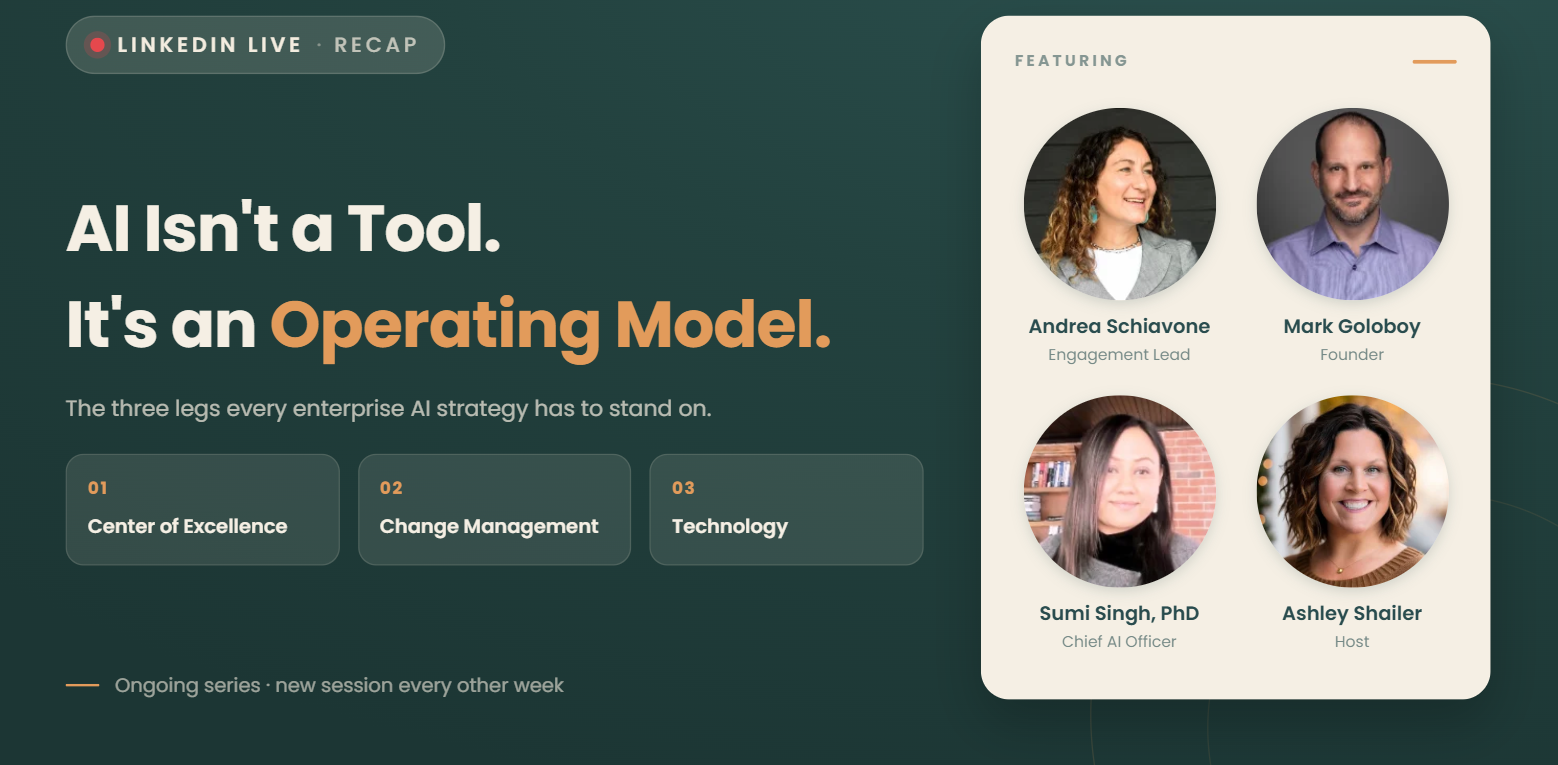
Last week our team got together on LinkedIn Live to compare notes on what’s actually working. The short version: the companies making real progress aren’t the ones with the best tools. They’re the ones treating AI as an operating model, and that model has three legs. A center of excellence. Change management. And technology. Kick out any one of them and the stool goes over.
Let’s take them one at a time.
I. Yes, “Center of Excellence” Is a Buzzword. Use It Anyway.
CoE, PMO – whatever you want to call it, Andrea Schiavone, who leads one of our largest engagements, put it plainly: it’s a buzzword, and she doesn’t hate it. Because underneath the jargon is something operators genuinely love. Structure. A container. One place where AI gets governed and owned, instead of a dozen pilots running in parallel with nobody comparing notes.
And that parallel-pilot thing? It’s everywhere. Marketing is testing something. Sales is testing something else. Both teams think they’re ahead. Neither knows what the other is doing.
“Everyone feels like it should be easy, but it is damn hard. There’s a lot of piloting happening. Marketing teams piloting, sales teams piloting, but nobody’s talking to each other, and there’s very little overarching governance.” — Andrea Schiavone, Engagement Lead, Market Growth Consulting
The good news is we’re watching this get fixed in real time. New roles are showing up. One of our clients created a Director of Marketing AI position, and what started as a side responsibility is quickly becoming a full-time job, one that we think lands at the VP level or higher before long.
If you’re wondering what to look for in that hire, the answer surprised us a little. It’s not a particular résumé. It’s curiosity. The person who never says “we’re set.” The person who’s constitutionally incapable of accepting the status quo. Backgrounds run the gamut; that trait doesn’t.
One more thing, because it matters at enterprise scale: a billion-dollar company can’t afford shadow AI quietly running in the corners. That’s a security problem and a best-practices problem, and it’s exactly what a center of excellence exists to prevent.
II. The Technology Is the Easy Part (Sort Of)
Our founder Mark Goloboy likes to say the technology is the easy part. What’s hard is people.
Every organization has early adopters and laggards, and you can spot them within the first week of an engagement. Some folks lean in immediately. They’re experimenting on their own, and they show up asking how to turn their personal wins into something the whole company can use. Others say some version of “it can’t possibly be as good as…” and quietly wait for the whole thing to blow over.
It won’t blow over. So change management is really about one thing: leveling the playing field so everyone gets the benefit, in their own work, in their own way.
Here’s the math that convinced us. Mark thinks about AI in terms of percentage of work done, and lately, with a well-crafted prompt and real thought behind the ask, Claude gets his strategic work about eighty percent of the way there. He reviews every word to close the gap. But eighty percent is a magic number, because it’s the same bar Accenture taught him for delegation early in his career: if someone can do it eighty percent as well as you, delegate it and manage to your level. AI now clears that bar for a lot of knowledge work. Once you see it that way, refusing to delegate to it stops making sense.
Want a cheap diagnostic for your own team? Offer AI training to the whole department and watch what happens. The people who raise their hands first are your future center of excellence. The ones who never sign up are telling you something too, and their managers should hear about both. One of our clients, a $2B organization, did a version of this before we ever showed up: they surveyed their marketing team for AI agent use cases and learned a ton just from who bothered to respond.
There are pockets of magic in every organization. The leadership job is finding them and turning them loose.
III. The Demo Is Lying to You
Okay, now the technology. Sumi Singh, our Chief AI Officer, has a distinction that explains why the tool that dazzled you online falls apart inside your company.
Engineers talk about two kinds of builds. Greenfield is the open field: nothing exists yet, you set up the security and the architecture exactly how you want, and everything just works. That’s the demo. That’s every demo. Then there’s the other kind.
“Greenfield is the demo you see. It’s a breeze. Then there’s brownfield, which is where ninety-nine percent of real value is. Workflows are deeply embedded. You can’t just build an AI-native workflow. You have to slowly transform toward it.” — Sumi Singh, Chief AI Officer, Market Growth Consulting
Your company is brownfield. Legacy systems, compliance requirements, workflows so embedded that people’s entire jobs are shaped around them. Sumi’s comparison is the LaGuardia rebuild: you can’t extend the footprint, you can’t stop the flights, and you have to construct something new while everything keeps running. That’s enterprise AI.
It’s why not one of the AI projects we’ve delivered in the past year ended the way it started. With Imagine360, a $200M insurance benefits company (we can name them; the case study is done), we walked in planning to build a Copilot agent. Their security requirements and Microsoft infrastructure had other ideas. We ended up building something completely different, learning techniques on the fly that, as far as we can tell, nobody had done before. The client still got everything we promised on day one. That’s the actual job. A project-based vendor ships the original spec and leaves you with something nobody adopts. A partner gets you the original value, whatever the path turns out to be.
IV. So What Do You Actually Do This Quarter?
We closed the Live with one question: if a senior leader at a billion-dollar company takes one action this quarter to get from AI theory to AI value, what is it? Three answers came back, and they rhyme.
Mark’s answer: force the specificity. Go to your CRO and your CMO and make them name their priority use cases and the value of each one. Do the back-of-envelope math together. You’ll know the AI potential of your organization by the end of the meeting.
Ask your CRO and CMO: what are your priority use cases, and what’s the value of each? Back-of-envelope math them. You would know right there the potential of AI in your organization. And if they can’t answer the question, get new executives.” — Mark Goloboy, Founder, Market Growth Consulting
Andrea’s answer: get an executive sponsor, pick your single highest-priority use case, and actually build and launch it. Not a pilot that dies in a slide deck. A real agent or workflow that people adopt. Momentum comes from the top down or it doesn’t come at all.
And Sumi’s answer, which might be the most important: start building the muscle now. Your use cases will change. The models will change (she jokes she’s eating technology for dinner every day just to keep up). But the capability compounds only if you start. This isn’t SaaS, where you buy the seats and the work is done. It’s a strategic capability you evolve the same way you evolve your strategy.