

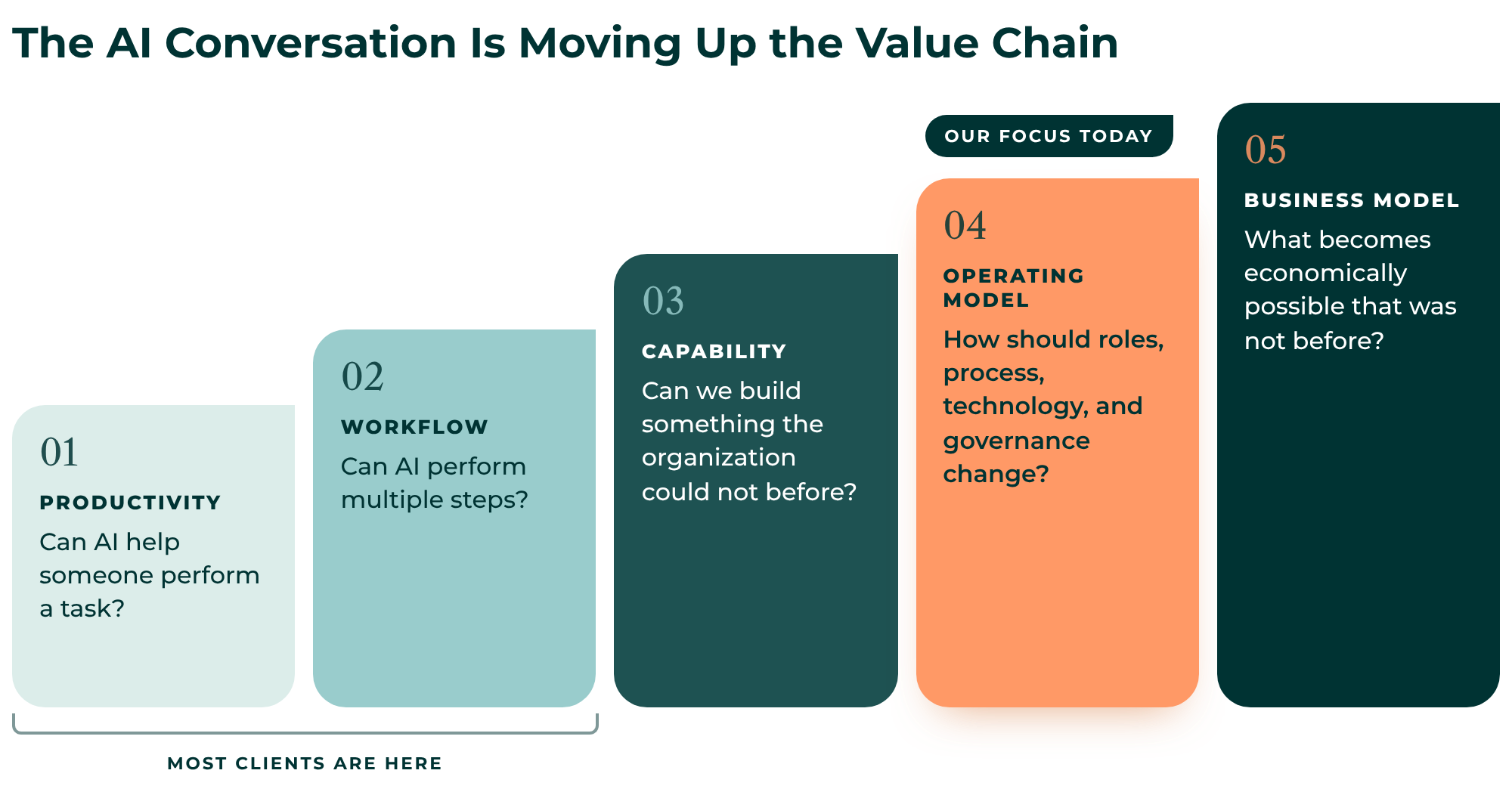
2027 planning season is here, and the AI conversation has moved up the value chain, from “can AI help perform a task?” to “how should roles, process, technology, and governance change?” That is an AI operating model question, and it can’t be answered by one AI enthusiast with a ChatGPT license.
Our takeaway after a year of AI transformation work with sales and marketing teams: it takes a village to do transformational AI. Not a big village, a deliberate one! AI engineers who build, change management experts who drive adoption, and business leaders who own the outcomes. Miss any one of the three and the initiative stalls: pilots without adoption, enthusiasm without architecture, or technology without a business case.
There is also a fourth requirement that most plans ignore: velocity. The AI landscape has reinvented itself roughly every twelve months: content generation in 2023, RAG and agents in 2024–25, orchestration in 2026. Whoever you staff this village with, internally or externally, must be able to keep pace with a frontier that moves quarterly.
This is where external developers and consultants can add value. They bring emerging skills, fresh perspectives, and hands-on experience to internal teams that have day jobs and limited bandwidth to keep up with the pace of change. Use the checklist below to pressure-test your 2027 plan.
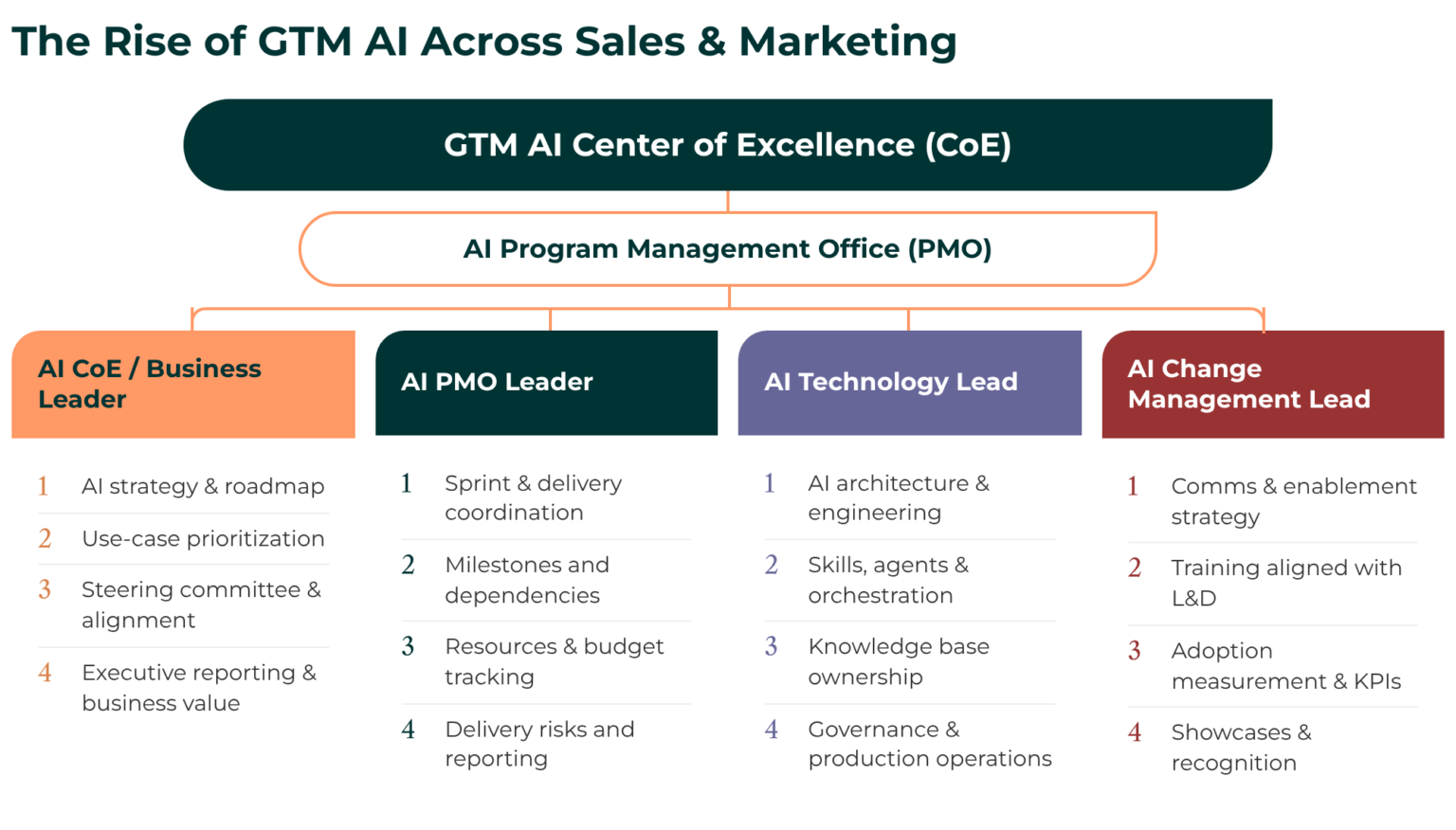
The village: four roles in your AI Center of Excellence
McKinsey’s research on the agentic organization describes the shift the same way we see it in GTM: the question is no longer whether AI can do a task, but how roles, workflows, governance, and technology change together. This shift requires two complementary structures: a GTM AI Center of Excellence (CoE) to build the discipline and a GTM AI Project Management Office (PMO) to drive the execution.
An AI Center of Excellence (CoE) is the cross-functional team that makes AI a lasting capability across departments. It sets direction and standards, builds shared foundations, develops talent, and demonstrates business value.
The AI PMO is the execution and coordination layer within the CoE. It manages intake, connects business and technical teams, runs delivery sprints, tracks dependencies and value, governs execution, and continuously reprioritizes work as business needs and AI capabilities evolve.
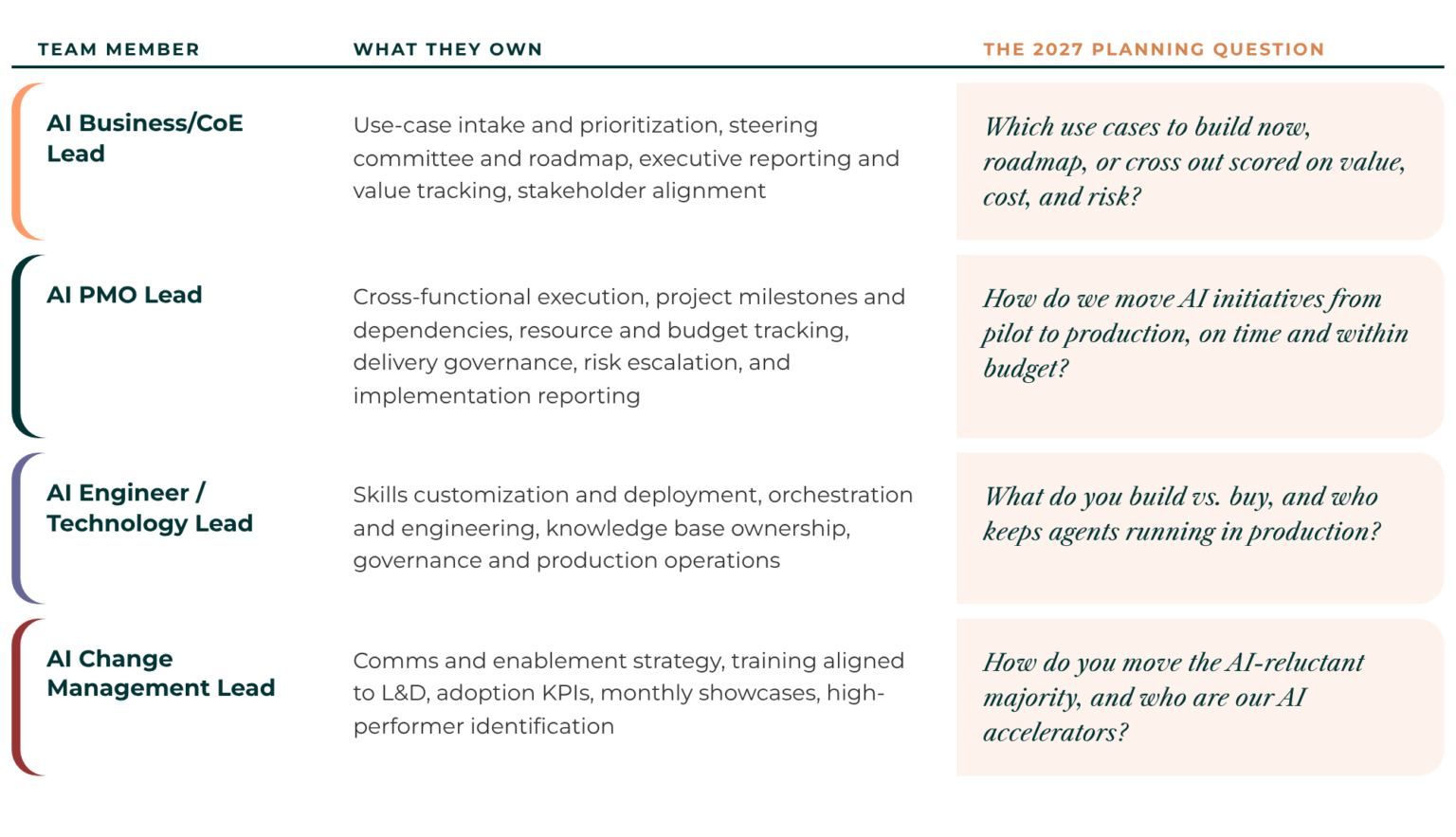
Microsoft’s Work Trend Index found that 82% of leaders say productivity must increase and 80% expect agents to supply that capacity. The village is how capacity actually arrives: business picks the work, engineering builds it, change management makes people use it.
The 2027 AI operating model planning checklist
Work through these before you lock in your 2027 budget. If you can’t check a box, you’ve found a gap in your organization worth investigating.
1. Set the business foundation: Your AI roadmap
- Define the business outcomes first. Start from “how do we achieve the outcome with humans + AI?”, not “how do we make the existing process more efficient?”
- Establish a GTM AI CoE with a PMO function to coordinate execution, supported by a steering committee, intake process, and prioritized roadmap.
- Score every use case on value, cost, and risk. Then sort into build now, roadmap, redesign the process, or not worthy.
- Ask the rebuild question: If we could design a sales and marketing org from the ground up today, would we build it the same way? Budget against the answer.
2. Staff (internal or external) the engineering muscle: Your AI readiness
- Name an owner for AI development, knowledge bases, and production operations.
- Consider AI as a shared service. Identify which functions and teams can co-own capabilities, and assign dedicated or dotted-line leaders to coordinate across them.
- Audit your stack: which tools solve problems AI now solves differently?
- Hire and screen for builders. Can your next demand-gen director build with AI tools from day one? Do they have the skillset and desire to learn to build in AI?
3. Fund AI adoption like it’s half the work
- Put enablement, training, and adoption KPIs in the plan with their own budget line.
- Identify your AI-curious and AI-reluctant team members and reward the curious visibly (showcases, recognition, performance evals), while upskilling those who are reluctant.
- Incorporate AI adoption and proficiency into performance evaluations, and identify high-potential AI talent at every level to develop into future AI champions and leaders.
- Make every GTM leader an AI role model; upskilling is for everyone, not just the tech team.
- Plan the human-agent balance per role: too few agents wastes capacity, too many overwhelms human judgment and results in agent sprawl.
4. Operate at AI speed
- Replace the annual transformation program with annual strategy, quarterly portfolio allocation, and two-week build sprints.
- Measure continuously and reprioritize as models and tools improve.
- Vet every partner and hire on one question: Can they keep up with a frontier that changes quarterly?
The pace test: can your village keep up?
McKinsey reported in July of 2026 that 92% of companies plan to increase AI investment over the next three years. Yet only 1% of leaders call their AI deployment mature. The gap isn’t budget. It’s people who can translate a fast-moving landscape into working systems and adopted habits.
GTM AI should behave like a product organization, not an IT project: build, deploy, learn, reprioritize. A partner who learned AI in 2024 and stopped is selling you last year’s AI operating model. Ask anyone you’re about to trust with this work what they’ve shipped in the last quarter and what they’ve changed their mind about in the last six months.
The bottom line
AI ideas are not scarce. Engineering capacity, data readiness, and management attention are. A 2027 plan that funds licenses but not the village buys tools, not transformation. A working AI operating model brings business ownership, engineering, and change management together, with the PMO driving execution at the speed of change in frontier AI. Review this checklist with your leadership team, find the unchecked boxes, and make a plan before January.
Want to continue the conversation? Contact us.
Sources
- Anthropic. Economic Index. Research on AI usage across occupations, tasks, and automation versus augmentation (June 2026)
- McKinsey. The agentic organization: Contours of the next paradigm for the AI era (September 2025)
- McKinsey. We’re all techies now: Digital skill building for the future (July 2026)
- Microsoft. 2025 Work Trend Index: The Year the Frontier Firm Is Born (April 2026)
- Market Growth Consulting. “How AI Is Reshaping the Revenue Operating Model,” SAMI session, October 2026

About the author
Sumi Singh, PhD
Chief AI Officer, Market Growth Consulting
Sumi leads AI strategy at Market Growth Consulting, helping sales and marketing teams move from AI pilots to an operating model that delivers value. She founded Generative AI Labs (GAIL180.com), has advised Fortune 500 companies, venture capital firms, and global organizations on AI technology, infrastructure, and speaks often on AI-powered transformation.