

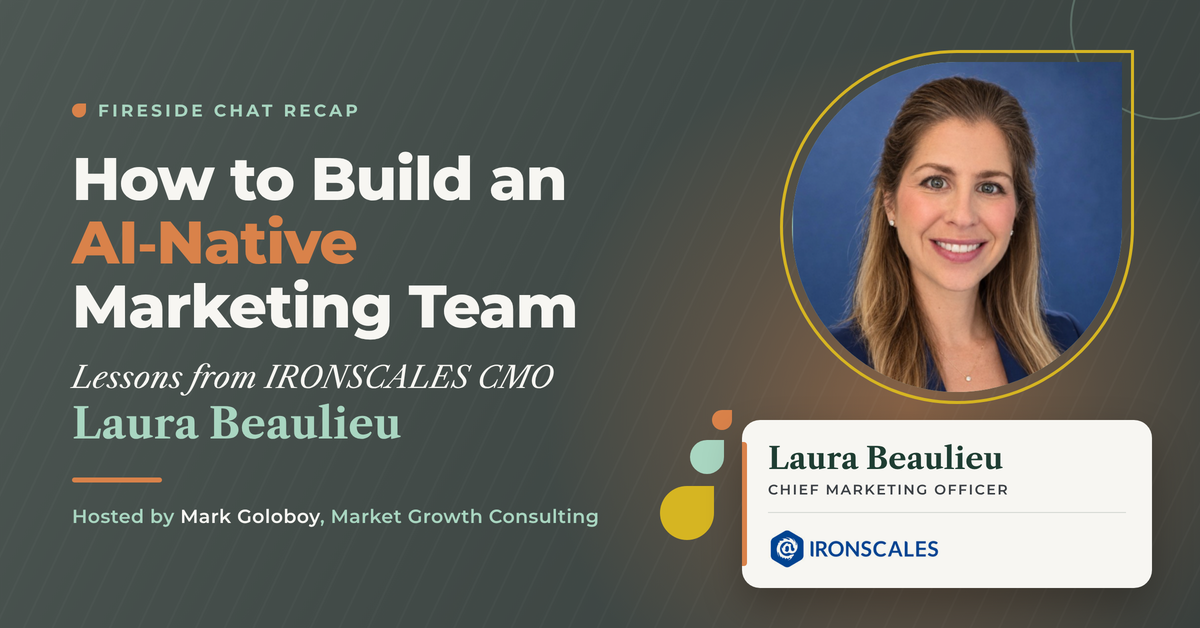
One AI agent gives the IRONSCALES marketing team back about 10 hours a week. Another, a hiring agent, scored candidates well but couldn’t read a room. Both taught CMO Laura Beaulieu the same lesson about building an AI-native marketing team: AI runs the process, and people own the judgment.
On November 6, Market Growth Consulting hosted a virtual fireside chat where Mark Goloboy, CEO of Market Growth Consulting, sat down with Laura Beaulieu, CMO of IRONSCALES, to talk about what it actually takes to build an AI-native marketing team. Laura joined IRONSCALES this summer as a fractional CMO through Market Growth Consulting and went full-time in October. Before that, she trained go-to-market teams to build skills and agents in Claude Code. Here’s what we took away.
What does an AI-native marketing team look like?
Many companies call themselves AI-native, but few actually are. When Laura arrived at IRONSCALES, the team was already building Claude skills, pulling data, and creating their own dashboards. But being AI-native goes beyond having employees who know how to use the tools. It means embedding AI into how the entire team works.
At IRONSCALES, that starts with investing in people and building AI capabilities across the organization. They prefer to train their existing employees on AI tools and agents rather than hire AI engineers.
- Structured training. Employees progress through Claude training, earning greater access as their skills develop.
- Different levels of proficiency. Some employees use Claude for everyday tasks, while others build skills, agents, and automated workflows.
- A culture of curiosity. Employees are asking for more time to learn AI, not resisting it.
Laura sees hesitation as a confidence issue, not resistance. With the right training and support, employees can move past the fear of making mistakes and start putting AI to work.
Where should humans own the work?
AI can handle repeatable, process-driven work, but human judgment, creativity, and an understanding of people are essential. Laura tested this while hiring. She built a Claude “hiring desk,” feeding it job descriptions, culture-fit criteria, and candidate resumes.
- What worked: It created a rubric and ranked candidates cleanly against the criteria.
- Where it fell short: It got no read on personality, interpersonal dynamics, or how someone would mesh with the team.
AI can help evaluate qualifications, but human judgment is still invaluable when making hiring decisions.
Why every AI agent needs a human owner
“Claude is almost like a really smart intern who could go really fast in any direction you set it.”
Laura Beaulieu, CMO, IRONSCALES
When a traffic spike took her website down, Laura asked Claude to restore the servers as efficiently as possible. Claude read “efficient” as “zero budget.” The result was four hours of approvals, API connections, and workarounds that never worked. Her lesson was blunt: Claude doesn’t always know better.
Mark reinforced the point with an analogy every manager can relate to: “If an intern makes a mistake and you hand in the work, it’s still your work.” The same rule applies to AI:
- Test it before you rely on it.
- Review what it produces.
- Own the result.
Workflow vs. agent: what’s the difference?
An attendee asked what separates an AI agent from an automated workflow. Laura explained that the key difference is the ability to make decisions and take action.
| Automated workflow | AI agent | |
|---|---|---|
| What it does | Runs predefined steps on a schedule | Makes decisions and takes action |
| IRONSCALES example | A daily dashboard pulling from HubSpot and Salesforce | A competitive intelligence agent that researches competitors, creates briefings, and posts them to Microsoft Teams |
| Business impact | Reduces manual reporting | Saves roughly 10 hours a week of competitor research |
Both improve efficiency, but agents go further by independently executing tasks that would otherwise require human involvement.
How to govern AI agents in marketing
AI agents aren’t set-it-and-forget-it tools. Laura noted that even when Claude operates reliably 98 to 99% of the time, model updates can unexpectedly change how an agent behaves, including its tone of voice. For marketing teams, that can have a significant impact on brand consistency. Three ways to maintain control:
- Build in a fail-safe stop. A failing agent should halt and notify its human owner.
- Monitor performance. You need to see what each agent is running and how it’s performing.
- Manage access. IRONSCALES has a head of AI. People start with narrow permissions, and access to things like pipeline data requires training and the right role.
Does AI replace copywriters?
Laura was clear that it doesn’t. Anyone who uses Claude regularly learns its habits, and part of her job is bringing the human voice back.
“Not everything can be Claude-ified.”
Laura Beaulieu, CMO, IRONSCALES
Where Claude helps is consistency. IRONSCALES built a brand skill that holds the company’s voice, look, and design rules, and it stopped brand drift in the decks people build for clients and conferences. Laura has also built 30 to 40 skills that capture her own cadence and stories.
Mark sees the copywriter role changing, not disappearing. Demand and product marketers can draft with brand skills. Copywriters shape those skills and take the work from 90% to 100%.
What should CMOs do first?
Start by getting hands-on with AI. Many companies hire one go-to-market engineer to support an org of 300 people. Laura wants a team of them.
“I want to have every single person on my team be able to build within Claude.”
Laura Beaulieu, CMO, IRONSCALES
Her one-year vision is a centralized “go-to-market brain” in Claude. It would know the plan, budget, owners, pipeline, and campaign results. A campaign described out loud could become an assigned project plan in Asana, and Claude would flag where to speed up or adjust.
Her advice for getting there is simple. Start small, but don’t stay small.
Here’s what we found
We’re seeing the same pattern across our clients. The teams getting real value from AI aren’t using it to replace marketers. They’re rethinking how work gets done, investing in their people, and building AI into everyday operations with clear ownership and accountability.
At Market Growth Consulting, we’re putting these principles into practice with our clients while continuing to experiment and learn ourselves. If you’re looking to build an AI-native marketing team, let’s talk about where to start.